

The psychology of lifestyle inflation
The psychology of lifestyle inflation
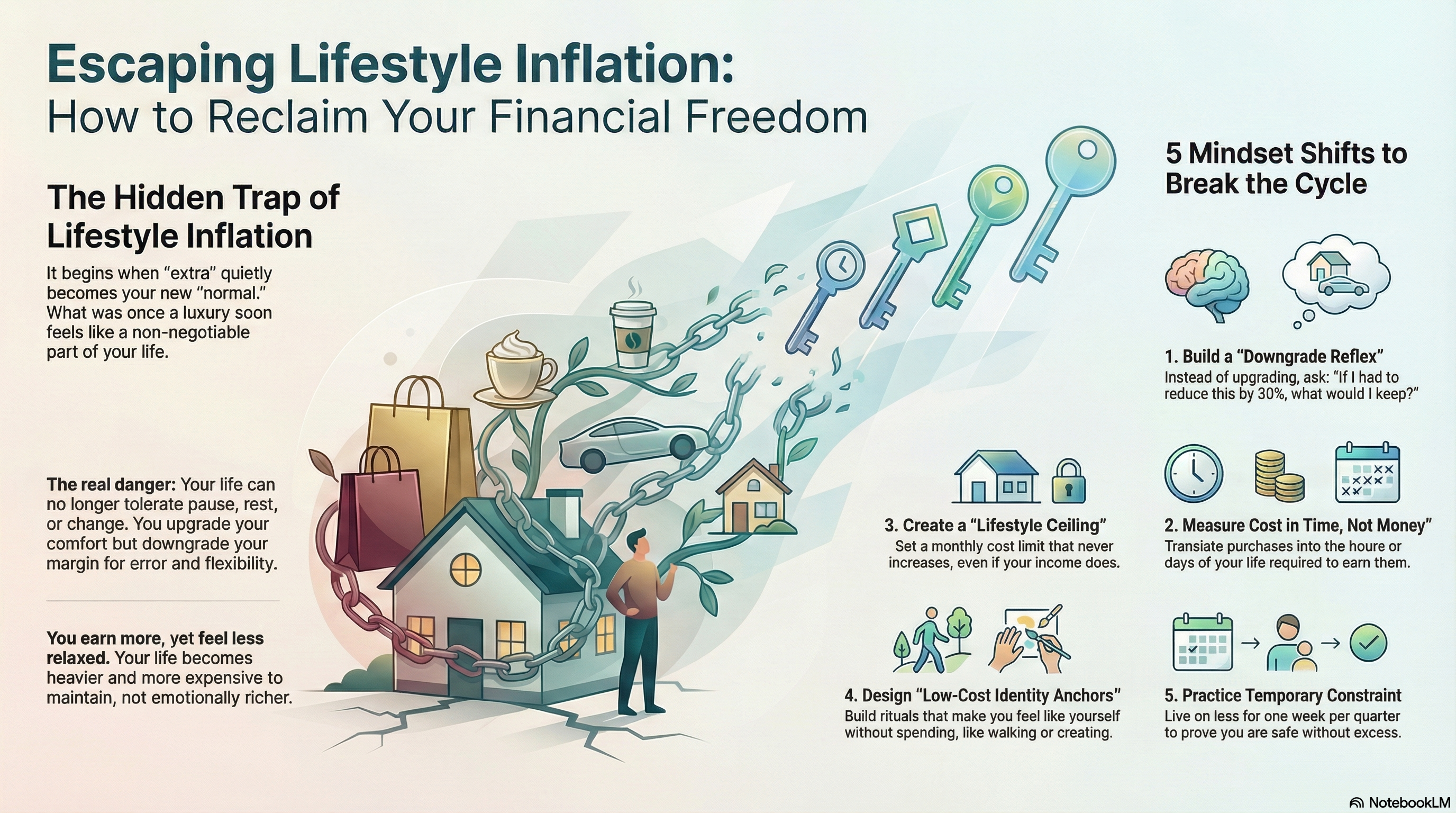
Lifestyle inflation doesn’t start when you buy expensive things.
It starts when your baseline quietly moves up.
What once felt like “extra” becomes “normal.”
And what becomes normal quickly turns into non-negotiable.
You don’t notice the shift at first.
You’re just “keeping up with your new level.”
But slowly, life becomes heavier.
Not emotionally richer.
Just more expensive to maintain.
You earn more, yet feel less relaxed.
You upgrade your comfort, but downgrade your margin for error.
And without meaning to, you design a life that can’t tolerate pause, rest, or change.
That’s the real danger of lifestyle inflation:
it removes your ability to step back.
Counter-Intuitive Ways to Break Lifestyle Inflation
These are not typical budgeting tips.
They’re psychological interventions.
1. Build a “Downgrade Reflex”
Most people only think about upgrading.
Train yourself to ask the opposite question:
“If I had to reduce this by 30%, what would I keep?”
Use Notion or Milanote to list:
– Your top 10 lifestyle expenses
– What would happen if each one was reduced, not removed
This rewires your brain to see options instead of fear.
2. Create a “Lifestyle Ceiling” (Not an Income Goal)
Income goals encourage inflation.
Ceilings create freedom.
Set a monthly lifestyle cost limit and commit to never crossing it — even if income rises.
Use Monarch Money or YNAB not to maximize spending, but to lock a ceiling.
This single move separates income growth from life complexity.
3. Measure Cost in Time, Not Money
Money feels abstract.
Time feels real.
Start translating purchases into days of your life.
A $1200 expense isn’t “affordable” —
it’s 3 full workdays you won’t get back.
Use Toggl or RescueTime to see how much time your income actually costs you.
Once you feel this, spending becomes intentional overnight.
4. Design “Low-Cost Identity Anchors”
Lifestyle inflation often supports identity, not need.
Ask:
“What makes me feel like myself without spending?”
Then build rituals around it.
– Walking
– Writing
– Training
– Cooking
– Creating
Track these in Habitify or Streaks.
You’ll notice something powerful:
the less you spend to feel whole, the harder inflation becomes.
5. Practice Temporary Constraint
Freedom grows under constraint.
Once per quarter, live one week on a deliberately reduced lifestyle.
Not forever.
Just enough to remind your nervous system: I’m safe without excess.
No new purchases are planned.
Convenience spending is completely off the table.
There will be no upgrades during this period.
This breaks fear-based consumption at its root.
What Changes When You Break Lifestyle Inflation Psychologically
Your income stops dictating your identity.
Your lifestyle stops expanding automatically.
You feel calm even on “average” months.
You’re no longer afraid of earning less — because your life can handle it.
Decisions become lighter.
Career moves feel possible again.
Rest no longer feels earned — it feels allowed.
You don’t feel like you’re missing out.
You feel like you’re finally in control.
That’s the shift most people mistake for “discipline,”
when it’s actually clarity.
The 5-Day “Lifestyle Reset” Challenge (Different & Fast)
This is not about saving money.
It’s about changing how your brain relates to spending.
End with one question:
“If my income doubled tomorrow, what would I not change?”
That answer is where freedom lives.
If earning more hasn’t made life feel lighter, the problem might not be income — but lifestyle inflation. This is exactly what “Why Financial Minimalism Beats High Income” explores, showing how our psychology quietly pushes us to spend more as we earn more.
