

The long-term cost of convenience
The long-term cost of convenience
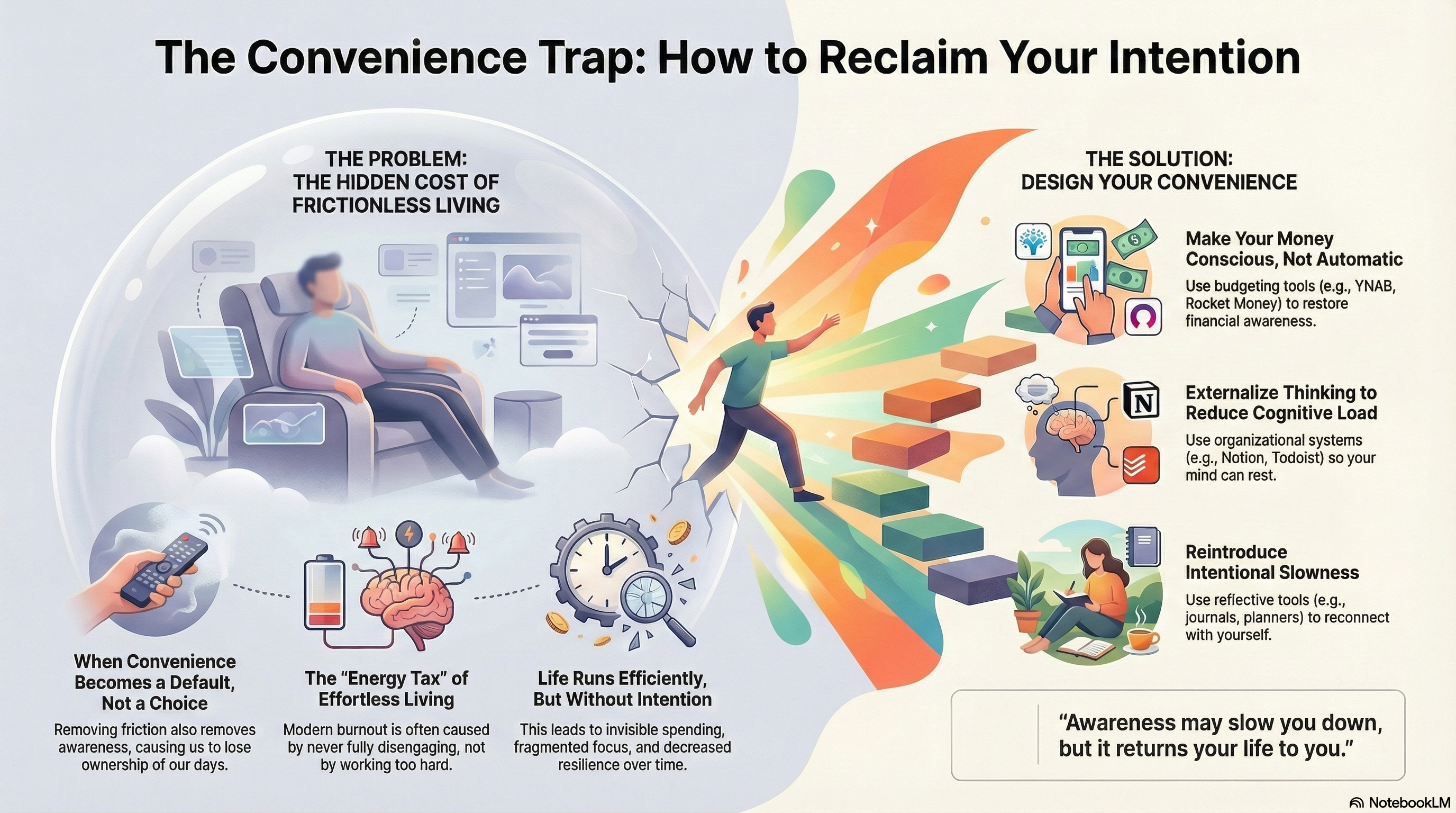
Convenience rarely feels like a problem.
In fact, it often feels like progress.
Your coffee arrives without waiting.
Monthly bills are handled automatically.
Over time, the calendar fills without intention.
Life becomes smooth. Predictable. Efficient.
Yet, beneath that smooth surface, something subtle begins to shift.
You stop asking questions.
The cost of trade-offs becomes harder to see.
Before long, choosing is replaced by default.
And the cost does not appear immediately.
It compounds quietly, over time.
When Convenience Becomes a Default, Not a Choice
Convenience is powerful because it removes friction.
However, friction is where awareness lives.
When everything is easy:
- Spending becomes invisible
- Commitments stack up silently
- Time loses structure
You save minutes here and there.
But slowly, you lose ownership of your days.
This is the long-term cost of convenience:
a life that runs efficiently, but without intention.
You may look productive.
You may look organized.
Yet internally, something feels off.
That feeling is not laziness or lack of discipline.
It is misalignment.
The Hidden Energy Tax of “Effortless” Living
Most modern burnout is not caused by working too hard.
It is caused by never fully disengaging.
Auto-renew subscriptions demand no decision.
Endless apps demand constant attention.
Notifications remove natural pauses.
As a result:
- Rest feels delayed
- Focus feels fragmented
- Recovery feels earned instead of natural
Over time, convenience trains your nervous system to stay alert.
Efficiency increases.
Resilience decreases.
The Goal Is Not Less Convenience—It’s Designed Convenience
Modern tools are not the enemy.
Unexamined systems are.
The solution is to make convenience visible again and design it to protect your energy.
Below are practical tools that help you do exactly that.
Practical Ways to Reduce the Long-Term Cost of Convenience
1. Make Your Money Conscious, Not Automatic
Money is one of the first areas where convenience hides cost.
Use tools like:
- YNAB (You Need A Budget) to intentionally assign every dollar
- Revolut for real-time spending insights and budgeting
- Rocket Money to track, review, and cancel forgotten subscriptions
These tools do not remove automation.
They restore awareness.
Result:
Spending slows down.
Anxiety decreases.
Financial decisions become values-based instead of reactive.
2. Externalize Thinking to Reduce Cognitive Load
Keeping everything in your head feels convenient—until it becomes exhausting.
Replace mental storage with systems:
- Notion for life planning, notes, and personal systems
- Todoist for clear task prioritization
- Google Calendar for time blocking and realistic boundaries
When structure lives outside your mind,
your mind finally rests.
Result:
Focus improves.
Decision fatigue drops.
Energy becomes available again.
3. Reintroduce Intentional Slowness
Speed disconnects you from yourself.
Slowness reconnects you.
Use analog or reflective tools such as:
- Passion Planner for goal alignment
- The Five Minute Journal for daily grounding
- A handwritten daily plan or reflection
These tools are not optimized for speed.
That is precisely their value.
Result:
Self-trust returns.
You feel present instead of rushed.
Choices feel deliberate again.
What Changes When Convenience Is Designed Intentionally
When convenience supports you instead of replacing you:
- Your days feel lighter
- Fewer decisions drain your energy
- Rest feels safe again
Over time:
- Burnout loses its grip
- Confidence rebuilds quietly
- Creativity reappears
Life stops feeling managed.
It starts feeling chosen.
The 7-Day “Reclaim Awareness” Challenge
The Long-Term Cost of Convenience
What ease slowly takes from a life, without asking.
This challenge is not an invitation to reject modern life.
It is an invitation to finally see the price we have been paying.
Closing Reflection
Convenience itself is not the problem.
Unexamined convenience is.
A life designed only for ease slowly loses its sense of agency.
Awareness may slow you down, but it returns your life to you.
Read article : What Sustainable Living Really Means
