

How to reduce your life’s “maintenance cost”
How to reduce your life’s “maintenance cost”
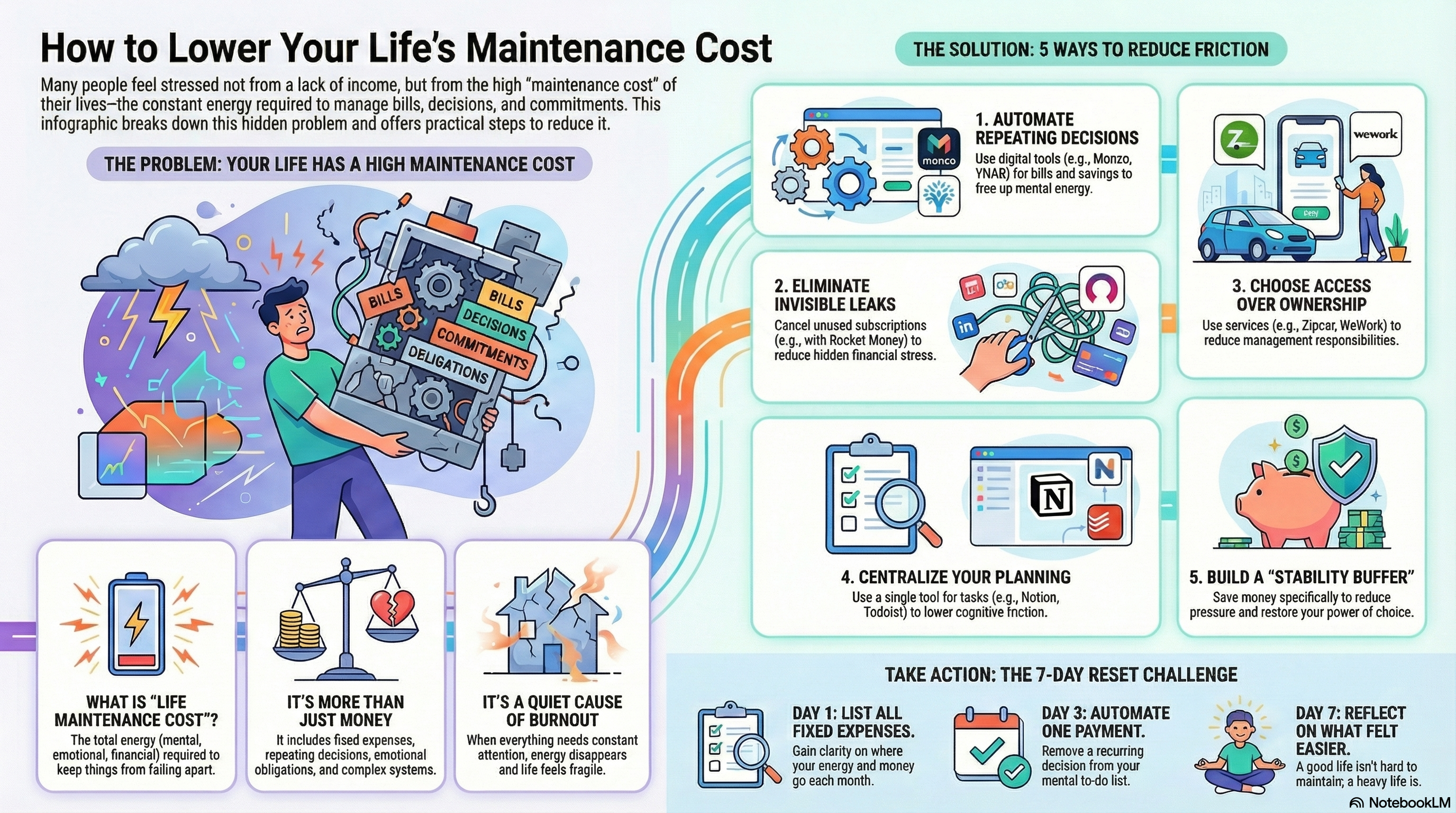
Most people think stress comes from not earning enough.
But more often, it comes from how much effort it takes just to keep life running.
Your days feel full before they even begin.
Bills, messages, reminders, and small decisions never stop.
You’re not failing—but you’re constantly maintaining.
And that’s the quiet problem:
Your life has a high maintenance cost.
Not just financially.
Emotionally. Mentally. Logistically.
When everything needs constant attention, energy disappears.
This is where burnout quietly starts.
What “Life Maintenance Cost” Really Means
Your life’s maintenance cost is the energy required to keep things from falling apart.
It includes:
- Fixed expenses
- Repeating decisions
- Emotional obligations
- Tools and systems that demand attention
Most lives are not intentionally designed.
They accumulate.
Subscriptions multiply.
Commitments stack up.
And suddenly, freedom feels expensive.
Reducing maintenance cost isn’t about doing less with your life.
It’s about removing friction from how your life runs.
Practical Ways to Reduce Your Life’s Maintenance Cost
1. Automate Repeating Decisions
Every repeated decision drains mental energy.
Automation gives that energy back.
Use digital banking tools like Monzo, Revolut, or Wise
to automate bills, transfers, and subscriptions.
Automate budgeting and saving with YNAB or Plum.
When money stops demanding daily attention, your nervous system calms down.
2. Eliminate Invisible Leaks
Most maintenance cost comes from things you’ve stopped noticing.
Cancel unused subscriptions with Rocket Money.
Track real spending behavior using Emma or Cleo.
Clarity reduces stress faster than cutting income goals.
3. Replace Ownership With Access
Ownership increases responsibility.
Access increases flexibility.
Use Airbnb instead of long-term leases.
Choose Zipcar or Turo instead of owning a car.
Work from WeWork or Spaces instead of maintaining a permanent office.
Less ownership means fewer things to manage.
4. Centralize Planning and Tasks
Scattered tools increase mental load.
Use Notion or Todoist as a single source of truth.
Plan your week in one place, not five.
A centralized system lowers cognitive friction.
5. Build a “Stability Buffer”
This is money saved to reduce pressure—not to buy things.
Even one month of expenses saved in Ally Bank
creates emotional safety.
Three months reduces panic-driven decisions.
Buffers lower maintenance cost by restoring choice.
What Changes When Maintenance Cost Drops
When your life requires less effort to maintain:
You feel lighter without trying.
Your days have margin.
Decisions feel calmer.
Rest stops feeling earned.
Over time:
- Confidence returns
- Creativity increases
- Energy becomes predictable
Life stops feeling fragile.
The 7-Day Maintenance Cost Reset Challenge
Don’t rebuild your life.
Just reduce friction.
Even a small shift reveals the truth:
A good life isn’t hard to maintain.
A heavy life is.
Reducing your life’s maintenance cost
is one of the fastest ways to regain time, energy, and sanity.
Lowering recurring costs doesn’t just change your finances — it changes how much effort your life requires to keep running.
When monthly obligations drop, something else quietly shifts: fewer decisions, less pressure, and less mental upkeep.
That’s where the next layer begins.
Because freedom isn’t only about money — it’s about how much energy your life demands every day.
In the next piece, “Small Monthly Costs That Trap Your Life Decisions” we go deeper into this idea by exploring life’s hidden maintenance cost — and how reducing it can ease stress, prevent burnout, and restore a sense of calm control.
