

How to Design a Life That Costs Less to Live
How to Design a Life That Costs Less to Live
Most people aren’t stressed because they don’t earn enough.
They’re stressed because their life has become expensive to simply exist inside.
Every month feels like a test you have to pass.
Bills arrive before you’ve even had time to breathe.
You work, not to move forward, but just to keep everything from falling apart.
And the quiet frustration is this:
You’re doing “well,” yet you still feel trapped.
You make money, but most of it disappears into things you don’t even enjoy anymore.
Your days are full, but your life feels small.
This is the part no one talks about:
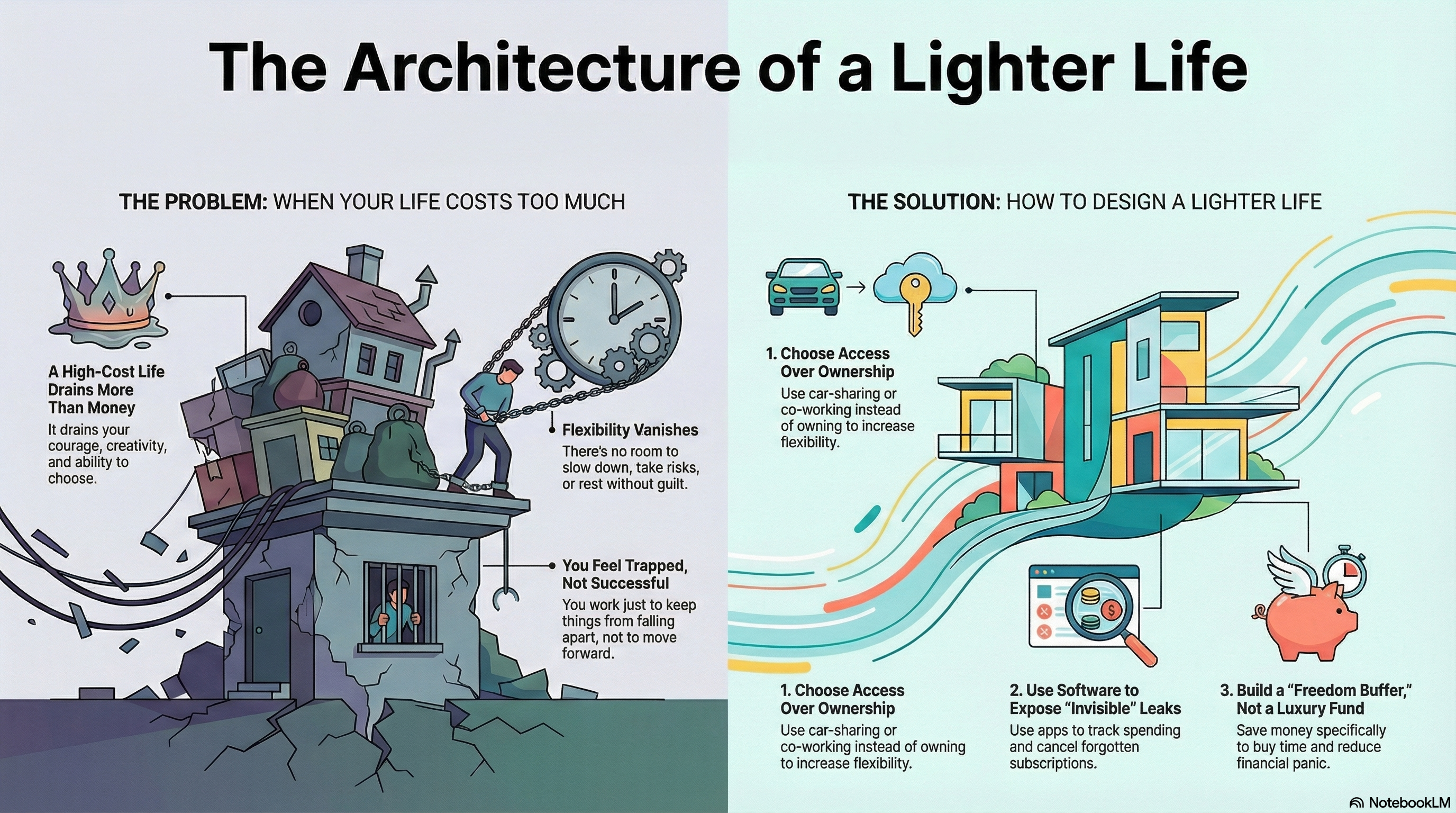
When life costs too much, you lose flexibility.
There’s no room to slow down.
Risk starts to feel dangerous.
Even rest carries a sense of guilt.
And deep down, you know it.
You feel it every time you say, “After this month, things will be easier.”
But the months keep stacking.
The Real Problem Isn’t Income — It’s Design
Most lives aren’t designed — they accumulate.
Commitments stack up. Subscriptions multiply.
Fixed costs rise,
while more things silently drain your time, energy, and attention.
A life that costs too much doesn’t just drain your money.
It drains your courage.
Your creativity.
Your ability to choose.
Designing a low-cost life isn’t about being cheap.
It’s about being intentional.
Practical, Modern Ways to Lower the Cost of Living (Without Lowering Your Life)
1. Replace ownership with access where possible
Ownership feels secure, but it’s expensive and rigid. Access is flexible.
– Short-term housing platforms instead of long leases
– Car sharing instead of car ownership
– Coworking instead of maintaining a home office
These services don’t just save money — they remove mental weight.
2. Use software to expose invisible leaks
Most people overspend not because they’re irresponsible, but because they can’t see clearly.
– YNAB or Copilot to reveal where your money actually goes
– Rocket Money to cancel subscriptions you forgot you even had
Clarity alone can feel like a raise.
3. Automate decisions that drain you
Every small financial decision costs mental energy.
– Smart banking apps like Monzo , Wise, or Revolut
– Automatic bill payments and savings transfers
When money stops demanding daily attention, your nervous system relaxes.
4. Build a “freedom buffer,” not a luxury fund
This is money saved not to buy things, but to buy time.
Even one month of expenses changes how you show up at work.
Three months changes how you see your future.
5. Design your lifestyle around recovery, not performance
A low-cost life includes lower emotional costs.
– Fewer obligations
– Fewer “shoulds”
– More margin between commitments
This is where real sustainability lives.
What Changes When Your Life Costs Less
- You don’t suddenly have less — you feel lighter.
- Your choices stop being driven by fear.
- You can say no without panic.
- You can rest without feeling like everything will collapse.
- Your life becomes adaptable again.
- You stop living paycheck to paycheck emotionally — not just financially.
And this is the shift most people never experience:
When your life costs less, you regain leverage over your time.
Confidence returns.
Creativity follows.
Life shifts from being managed to being chosen.
The 7-Day “Lower the Cost of Life” Challenge
Don’t overhaul your life. Just test a lighter version of it.
If you feel even a small shift, you’ll understand something important:
A good life isn’t expensive.
A heavy life is.
And designing a life that costs less
might be the fastest way to finally live more.
Living smaller is only half of the story.
Because for most people, the pressure isn’t coming from lack of income —
it’s coming from the rising cost of simply existing inside their own life.
That’s where the real problem begins.
For a deeper dive into why modern life feels so heavy in the first place, check out our full article: “Why a Smaller Life Gives You More Options”
