

Escaping the loop: work → spend → stress → repeat
Escaping the loop: work → spend → stress → repeat
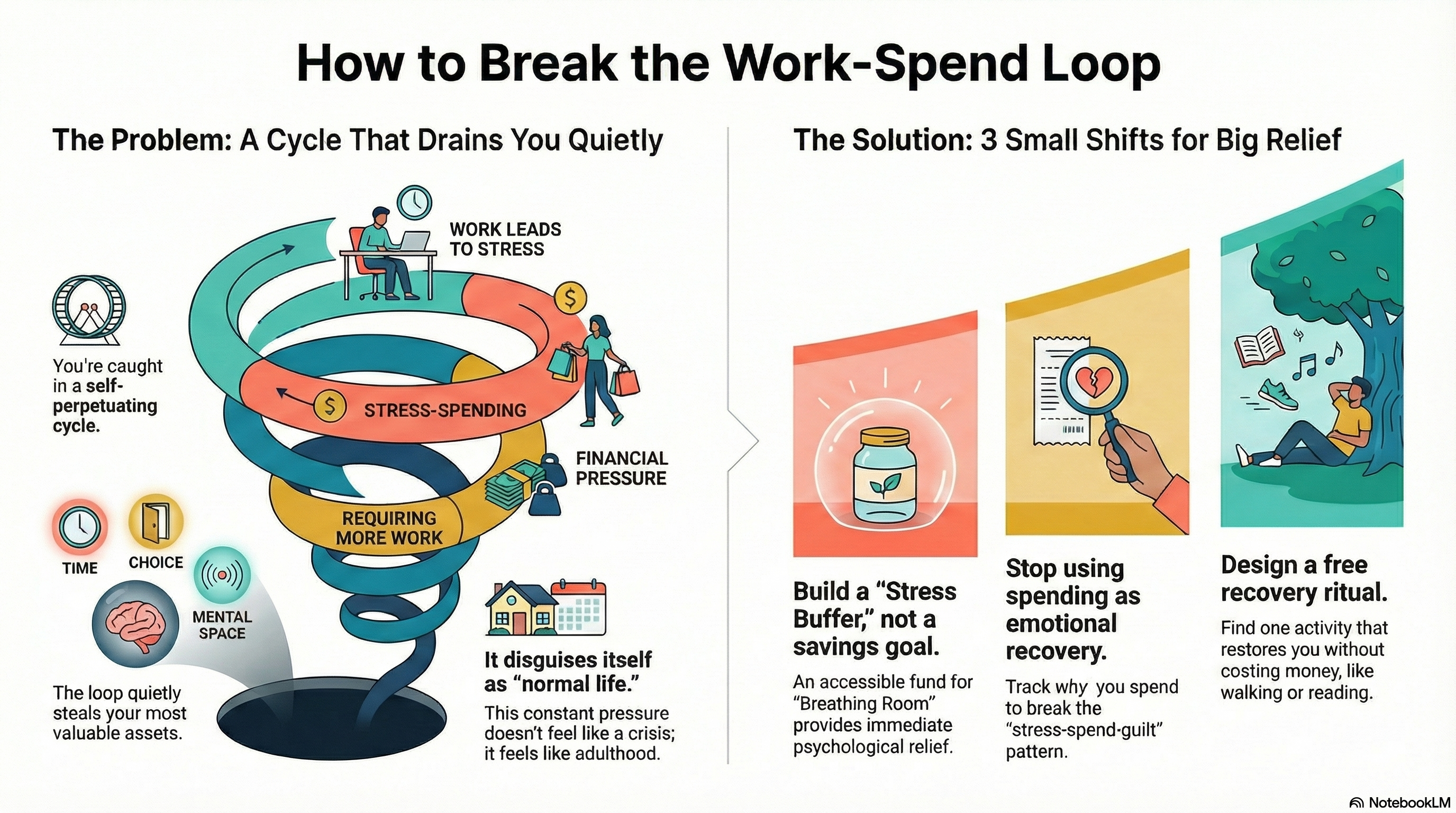
Most people don’t feel stuck because they’re lazy or unmotivated.
They feel stuck because they’re caught in a loop that quietly drains their energy every single day.
You work hard to keep up.
You spend to recover from working hard.
Then stress shows up — because the money disappears faster than the exhaustion.
So you work more to fix it.
And the loop repeats.
At first, it feels normal. Responsible, even.
But over time, something shifts. You’re always tired, yet never fully rested. Always busy, yet somehow behind. You make money, but it never creates space — only pressure.
The scariest part?
The loop doesn’t feel like a crisis. It feels like life.
So most people never question it.
They just adapt.
They tell themselves, “This is adulthood.”
“This is what stability costs.”
“One day, it will calm down.”
But the loop is designed not to calm down.
It survives by keeping you reactive — working to fix stress caused by spending you didn’t fully choose.
That’s why escaping it isn’t about earning more.
It’s about interrupting the pattern.
How the Loop Really Controls Your Life
The loop takes away three things quietly, without asking permission:
Time — because rest has to be earned.
Choice — because every decision has to fit the budget.
Mental space — because money is always somewhere in the background.
You’re not failing at life.
You’re just living inside a system that never taught you how to pause.
Practical, Modern Ways to Break the Loop
These aren’t extreme changes. They’re pressure releases — small shifts that create immediate relief.
What Changes When You Step Out of the Loop
You don’t suddenly become rich.
You become calm.
Work stops feeling like a trap.
Spending stops feeling like a mistake.
Stress stops running your schedule.
You start making decisions from clarity instead of urgency.
You realize you don’t need to escape your life — you need to slow it down enough to choose it.
That’s when real freedom shows up:
not in big upgrades, but in quiet control.
The 7-Day “Loop Break” Challenge
Don’t fix everything. Just interrupt the pattern once.
If you feel even a small shift, that’s the point.
Because escaping the loop doesn’t require a new life.
It requires one moment where you stop reacting — and start choosing.
And that moment can start today.
If life feels fast even when nothing is “wrong,” the reason may be a hidden financial loop quietly draining your energy — here’s how it works.
check out our full article: What a Slower Life Actually Looks Like
